The one most people skip
Queluz Palace
A rose-pink Rococo palace and formal gardens halfway between Lisbon and Sintra — and the easiest royal palace in the country to actually enjoy.
Let’s be honest about Queluz: it won’t give you the jaw-on-the-floor moment Pena does — there’s no painted castle floating above the clouds — and that is precisely the point. Queluz is the most relaxed royal-palace visit anywhere near Lisbon: a rose-pink, eighteenth-century Rococo summer palace set in formal French gardens, with no hill to climb and rarely a queue. Inside it unfolds as a sequence of set-pieces — the mirrored, gilded Throne Room, where carved Atlas figures hold up the painted ceiling and where the state still holds presidential dinners today; the circular Don Quixote Chamber, its walls painted with scenes from Cervantes, where King Pedro IV was both born and died; the Ambassadors’ Room. Outside, clipped box hedges and statues lead down to the Canal dos Azulejos — a long tiled waterway the royal family once dammed and flooded so they could drift along it by boat, between walls of painted ceramic seascapes.
The royals dammed a river so they could boat through their own garden, between walls of painted tiles.
What to see
- The gilded, mirrored Throne Room — still used for state dinners today
- The Don Quixote Chamber, where Pedro IV was born and died
- The Canal dos Azulejos — a tiled waterway the royals boated along
- Formal French gardens with no hill and rarely a queue
The Throne Room isn’t a frozen museum — it still hosts state and presidential dinners, so you’re standing in a working ceremonial room, not a roped-off relic.
Why visit Queluz
Here is the case for Queluz, plainly: after a day fighting Sintra’s crowds and gradients, it is the palace where you can finally hear yourself think. The rooms are gilt and mirror, not Gothic drama; the gardens are symmetry and calm, not wild romance. It is smaller than the hill palaces, so an hour to ninety minutes does it justice — and because most day-trippers skip it, you will often have whole rooms to yourself, with no timed-slot scramble and no shuttle queue. Would we send a first-timer with a single day here ahead of Pena or Regaleira? No. But if you have half a day spare, or you simply prefer gilt-and-gardens to Gothic theatre, Queluz is a genuine, low-stress pleasure — and the single easiest royal palace in Portugal to reach by train.
The full story
Queluz started in 1654 as a country house granted to the future Pedro II, but the palace you walk today is two building campaigns: Mateus Vicente de Oliveira's 1747 expansion, then a larger 1760 phase led by the French architect-goldsmith Jean-Baptiste Robillion, who shaped the east wing and gardens. It was built as a summer leisure retreat and only became the official royal residence in 1794, after a fire at the Ajuda palace forced the move.
The rooms reward slowing down. The Music Room is the most authentic interior in the building, practically unchanged since the 1761 inventory, with carved violins hung from the concave ceiling and a restored Clementi pianoforte still played at concerts. The Ambassadors Room has twin thrones on paired daises, so monarch and heir could preside together. The Room of the Skylight got its skylight on the orders of General Junot, Napoleon's invasion commander, who hoped to host Napoleon here.
Outside, look past the parterres. The Grand Cascade is a Rococo wall of "grotesque rocks" fed from an upper reservoir; the star-shaped Medallions Lake is the largest pool; and the Botanical Garden, where pineapples were grown for Pedro III, won two Europa Nostra awards after its 2018 restoration. Much of the lead statuary across the grounds came from John Cheere's London workshop.
Getting there
Queluz has its own station — Queluz–Belas — and this is the bit that trips everyone up: you do not get off at Sintra. From Rossio in Lisbon it is about 18–20 minutes on the Sintra line, with roughly three trains an hour; from Sintra itself it is a similar ride back down the line. From Queluz–Belas it is a flat, signposted 12–15 minute walk to the palace: head out along Avenida António Eanes as it becomes Avenida da República and keep going straight — the gates are at the end. There is a taxi rank outside the station if you would rather not walk.
Plan your visit
Queluz keeps simpler hours than the big Sintra sites and closes one day a week — confirm the current day’s opening before you wedge it into a tight train schedule.
Don’t bolt Queluz onto a Sintra day and then double back for it. It sits between Lisbon and Sintra on the same line, so stop on the way out, or on the way home — never as a there-and-back detour from the hills.
Accessibility
Largely level palace floors and garden terraces make Queluz one of the gentlest royal palaces to visit — a real relief if the Sintra hills have already worn you out — though a few interior steps remain.
Good to know
- Last admission is 17:30 for both palace and gardens; the palace closes at 18:00 and gardens at 18:30. The ticket office shuts 12:00-13:00, but automated machines stay open over that window.
- There's no official suggested route or visit time. Walk the interiors first, then the gardens, and budget more than you think for the terraces, the 115m canal and the Grand Cascade.
- The garden is multi-level by design, with balustrades, terraces and stone stairs between the upper gardens, the canal and the cascade. The official accessibility page wasn't reachable at the time of writing, so check current step-free and mobility access directly before you travel if that matters to you.
- Facilities detail is thin from the official source. A cafe/restaurant is listed but not named, and on-site toilets, parking, picnic areas and dog policy aren't confirmed, so don't count on them without checking ahead.
- Don't skip the Equestrian Art Library on site, a public collection of around 2,000 titles on equestrian art, open Tue/Wed/Thu mornings and afternoons by prior booking only.
- By train, take the Sintra line to Queluz-Belas or Monte Abraao, each about 1km from the palace; several Lisbon-area buses also stop nearby, and by car it's the 'Queluz-Palacio' exit off the IC19.
- Some point-of-interest pages carried a visitor-restriction notice for July 2026, so confirm the palace is fully open before you lock in a date.
Walk the Canal dos Azulejos at the foot of the gardens — the long tiled waterway is the one thing here you’ll see nowhere else in Portugal.
Queluz Palace: your questions
Which train station do I use for Queluz Palace?
Queluz–Belas, on the Lisbon–Sintra line — not Sintra station. It is about 18 minutes from Rossio in Lisbon, then a flat, signposted 12–15 minute walk to the palace along Avenida António Eanes / Avenida da República.
Can I walk from the station to Queluz Palace?
Yes — it is an easy, flat 12–15 minute walk from Queluz–Belas station: straight out along Avenida António Eanes as it becomes Avenida da República, and the gates are at the end. There is also a taxi rank at the station.
Why is it called the Portuguese Versailles?
For its eighteenth-century Rococo style and formal French-inspired gardens — symmetry, fountains, gilded rooms and a tiled canal, in the spirit of the great French palace.
Is Queluz worth it if I only have one day in Sintra?
On a single day we’d still send you to Pena and Regaleira first. Queluz is the star of a half-day or a second day, or a stop on the train to or from Sintra — not a same-day add-on you backtrack for.
Which room at Queluz is the most original and least restored?
The Music Room. It's stayed practically unchanged since the palace's first inventory in 1761, down to the carved violins and instruments hung from the concave ceiling. It still holds a restored Clementi pianoforte beneath a portrait of Queen Maria I, and it's still used for concerts today, so it's the closest you get to seeing the palace as the royal family did.
Is the tiled canal just decorative, or did it actually have a use?
It's a working watercourse, not a pool. The 115m canal carries the Jamor River, and on summer afternoons the royal family took gondola and boat trips along it while the Queen's musicians played, with the water level held up by sluice gates. At night, torches were lit in gilded cornucopia-shaped holders along the banks.
Is Queluz still used for anything official today?
Yes, it isn't a frozen museum. The Throne Room still hosts state concerts and presidential banquets for visiting heads of state, and the Queen Maria I Pavilion has served as a residence for visiting foreign heads of state since the mid-20th century.
Explore more of Sintra
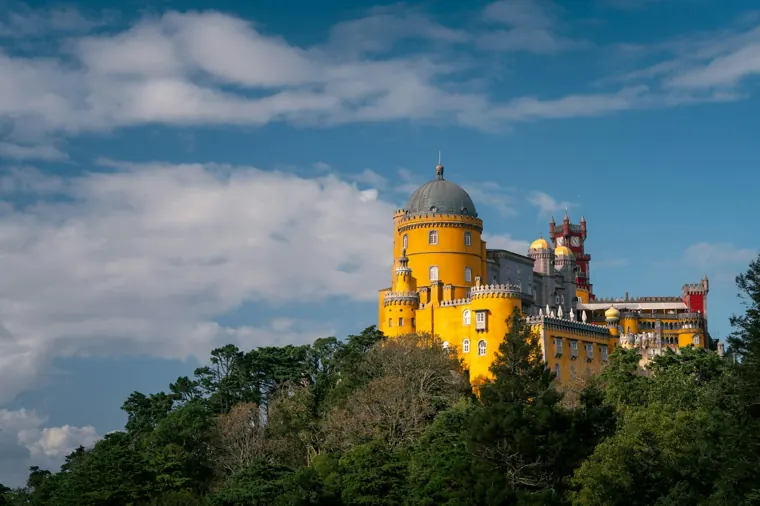 The one everyone comes for
 Pena Palace
Sintra's most-photographed sight — book the first slot and treat it as a two-hour commitment, not a quick stop.
Read the guide →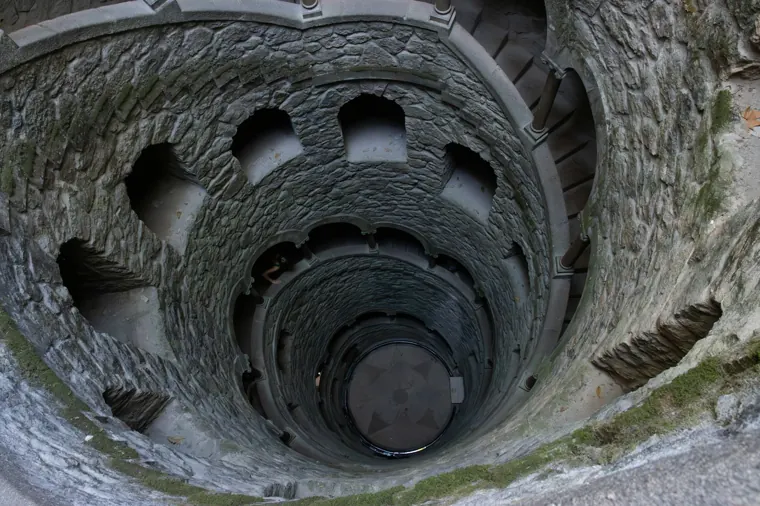 The one you walk into, not up
 Quinta da Regaleira
An early-1900s estate built as a coded garden — the descend-the-well-and-exit-the-tunnel move is the whole point.
Read the guide →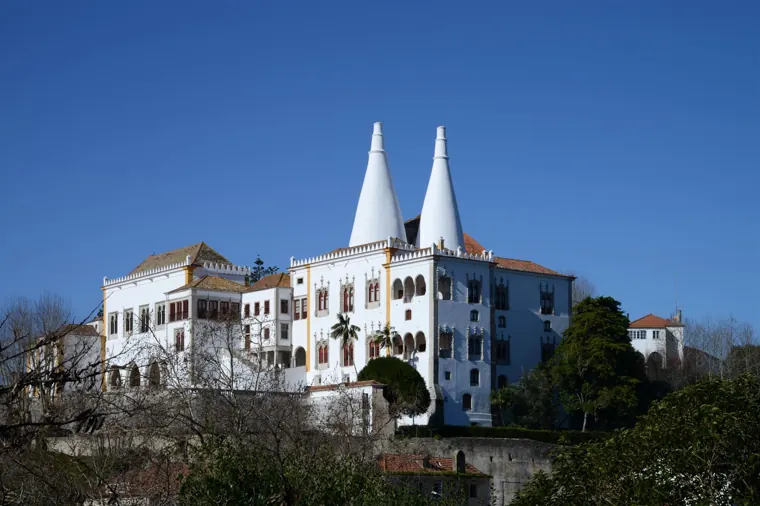 The tower everyone underrates
 Sintra National Palace
The town-centre palace people photograph from the square and then walk straight past.
Read the guide →